We use cookies.
Cookie Settings
We use cookies on our website to give you the most relevant experience by remembering your preferences and repeat visits.
Strictly Necessary
Necessary cookies are absolutely essential for the website to function properly. These cookies ensure basic functionalities and security features of the website, anonymously.
Analytical or performance
Analytical cookies are used to understand how visitors interact with the website. These cookies help provide information on metrics the number of visitors, bounce rate, traffic source, etc.
Functionality or appearance
Functional cookies help to perform certain functionalities like sharing the content of the website on social media platforms, collect feedbacks, and other third-party features.
No results found
Perspectives
With
LUKE REVELEY
Associate Director
A look back on a post-war commercial landmark to see how the flexible, open design by TP Bennett in 1963 helped to lay the foundations for its new life as the Museum of London more than 60 years later.
You must accept functionality cookies to view this content.
When architects, TP Bennett & Son and engineer, Ove Arup were commissioned to design a new building for Smithfield Market in 1960, the brief was for an unashamedly modern poultry market, fit for the twentieth century. The original Victorian poultry market to the west of the main site had been designed by the City of London’s architect, Sir Horace Jones, but was destroyed during a fire in 1958 that raged for more than three days and was one of the worst the city had seen since the Blitz.
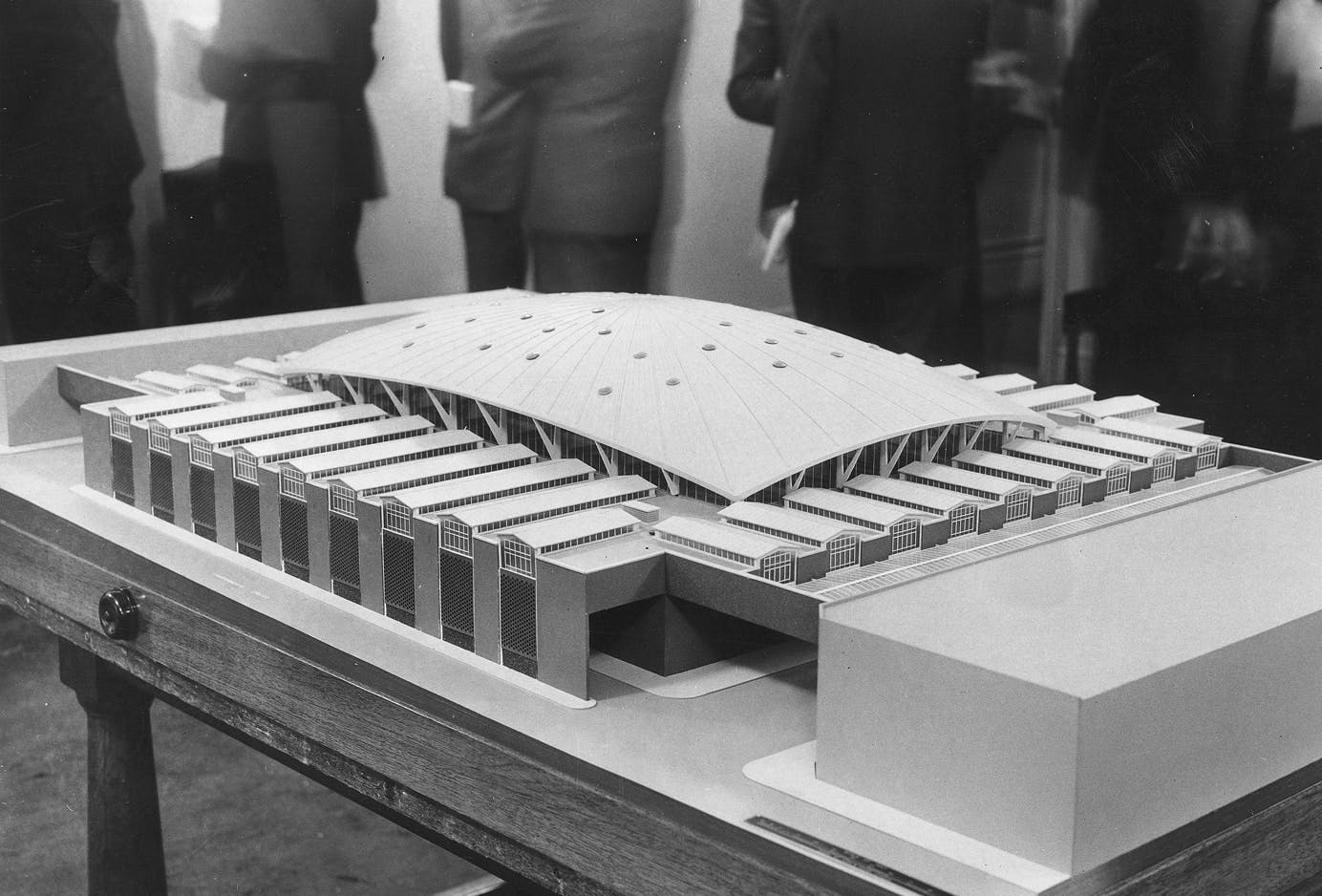
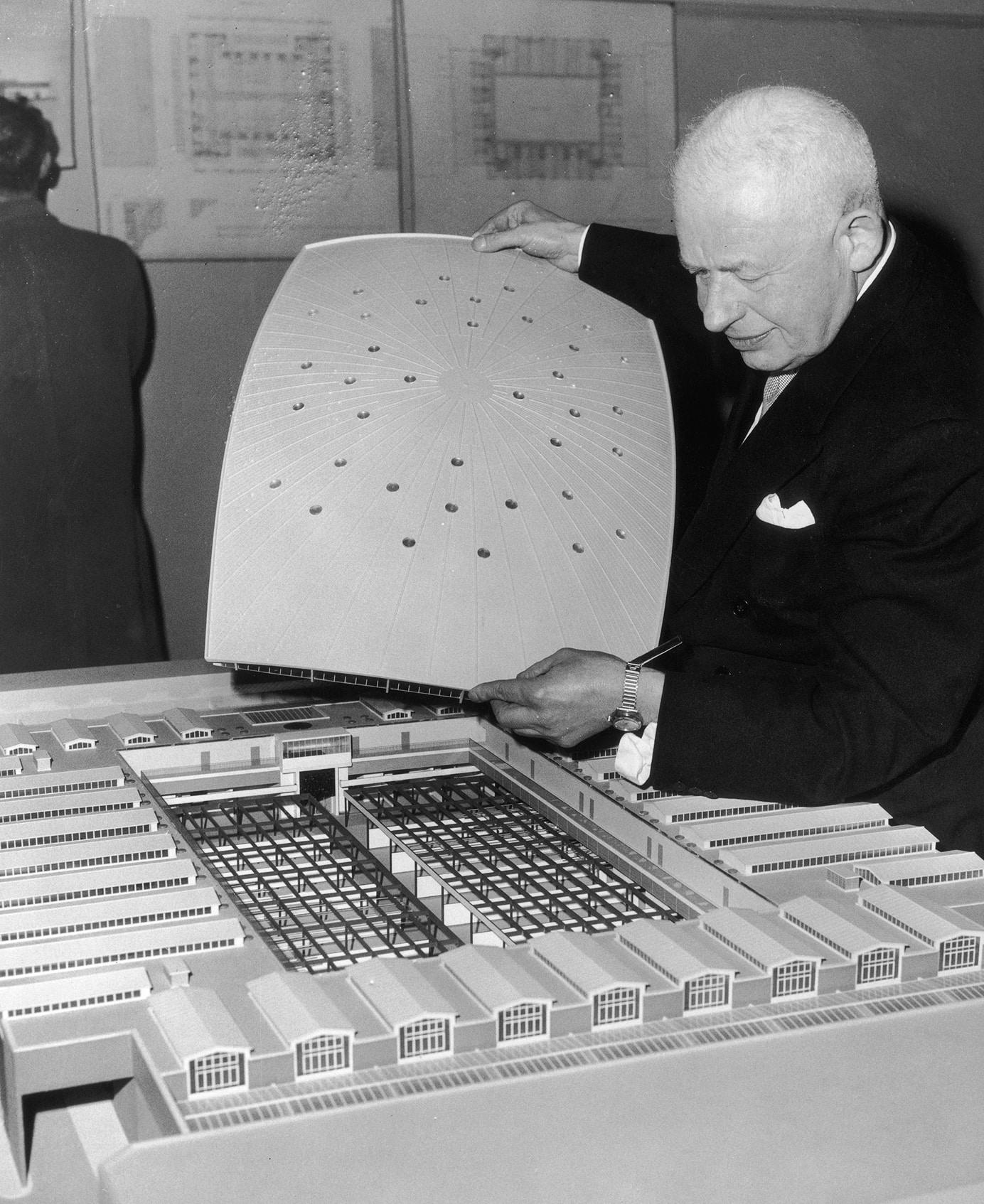
Their initial concept divided the market into two levels, with vehicle access across the ground floor and the market on the first floor. However, Smithfield’s market traders and porters rejected this idea, not wanting to haul meat up and down between floors. The plans were reconfigured to create a more traditional market on the ground floor, with offices around the perimeter on the upper level, linked by a walkway overlooking the market hall and a glazed control room. The basement was used for storage and a workers’ pub. Unassuming from the exterior with its rows of ground floor loading bays, the building’s drama comes internally from a vast elliptical paraboloid roof – at its time, believed to be the largest shell structure in Europe.
The architectural solution required innovative technology to realise the virtually column-free layout, so the design team approached Ove Arup, who had been developing innovative wide span roofs using shell concrete for some time. This project gave the ideal opportunity to put these ideas into practice at a large scale. They developed a pioneering structure that minimised the internal supports needed, creating a domed roof to enclose the whole poultry market: an elliptical paraboloid that used pre-stressed edge beams, creating a thin reinforced concrete shell that seems to barely touch the walls at the four corners. The innovative nature of this structure and the lack of existing data in support of this technology meant the dome had to be tested in a 1 to 12 scale model suspended from inflated balloons – a necessary, though rather expensive process that took six months. Still amazing today is the apparent lightness of the concrete shell and the delicacy with which it rests on the plinth.
The poultry market is a testament to close, precise architectural and engineering collaboration in the pursuit of the ideal synthesis of form and function that still characterises the practice’s work today. Natural light was key to the building’s clarity: the architects introduced a large, unobstructed clerestory window on all sides, flooding the market hall with light. The building’s simplicity is then complemented by more intricate, sometimes unexpected details, such as hexagonal glass block walls and circular skylights.
The trade of meat and produce in Smithfield has helped to feed the city for more than a century, but as today’s traders now make plans to move to the Royal Docks in the east of London, the market is once again being transformed. Just as TP Bennett & Son took over from Horace Jones to rethink the accommodation of different functions on the site in 1960, the poultry market, now Grade II listed, is being restored and refurbished by a new team of architects for a new use. The renovated London Museum is opening in 2026, welcoming the public to enjoy these great, previously unseen engineering and architectural advances for the first time.
More perspectives